How Long Does It Take for Water to Dry? The Complete Cleanup Guide
Facing Water Damage Right Now?
Our emergency crews arrive on-site within 60 minutes with direct insurance billing.
Discovering standing water inside your home triggers an immediate race against the clock. Property owners frequently ask our team: How long does it take for water to dry completely after a leak, spill, or flood?
The straightforward answer is that standard materials usually take 24 to 72 hours to dry under proper structural drying conditions. However, hidden moisture behind walls or under subfloors can linger for weeks if left untreated. At Water Extraction Now, our field technicians measure structural drying times daily using specialized moisture meters.
Understanding the drying timeline and the critical variables that accelerate or delay it is essential to preventing long-term structural degradation and mold contamination.
What Determines the Water Drying Timeline?
Water does not evaporate at a uniform rate. Several environmental and structural factors directly govern how rapidly moisture leaves porous materials.
1. Extent of Water Contamination (Water Category)
-
Category 1 (Clean Water): Sourced from broken supply lines or sink overflows. Dries fastest with minimal health risk.
-
Category 2 (Gray Water): Originates from dishwashers or washing machines. Requires sanitization during drying.
-
Category 3 (Black Water): Sewage or river flooding. Requires complete removal of porous materials rather than drying.
2. Relative Humidity and Temperature
Air temperature and relative humidity (RH) dictate evaporation rates. Warm air holds more moisture than cold air, but high ambient humidity halts natural evaporation.
3. Air Movement and Ventilation
Stagnant air creates a localized boundary layer of high humidity over damp surfaces. Continuous air movement breaks this layer, forcing moisture out.
Material-by-Material Drying Time Breakdown
Different building materials retain moisture at varying rates due to their porosity and density.
| Material Type | Average Drying Time | Primary Risk Factor |
| Carpet & Padding | 24 – 48 Hours | Delamination & Odor |
| Drywall & Plaster | 48 – 72 Hours | Structural Sagging & Mold |
| Hardwood Flooring | 7 to 14 Days | Cupping & Buckling |
| Concrete Subfloors | 5 to 30 Days | Moisture Retention Under Vapor Barriers |
| Plywood Subflooring | 3 to 7 Days | Delamination & Swelling |
Detailed Breakdown: How Long Does It Take for Water to Dry by Area?
How Long Does It Take for Carpet to Dry?
Surface carpet fibers often feel dry within 24 hours when exposed to high-velocity air movers. However, carpet padding acts as a dense sponge.
-
Without professional extraction, carpet padding remains wet for 4 to 7 days.
-
If padding stays wet beyond 48 hours, microbacterial growth accelerates rapidly.
-
Learn more about professional extraction techniques at [Internal Link: Water Damage Restoration Process at Water Extraction Now].
How Long Does It Take for Water to Dry Behind Walls?
Drywall absorbs liquid water through capillary action. Water running down interior studs becomes trapped inside wall cavities.
-
Standard sheetrock takes 48 to 72 hours to dry when structural cavity drying equipment is applied.
-
Insulation (especially fiberglass batts) loses its R-value when wet and often requires physical replacement.
-
You can cross-reference standard structural drying guidelines at IICRC S500 Standard for Professional Water Damage Restoration.
The 4-Step Professional Structural Drying Process
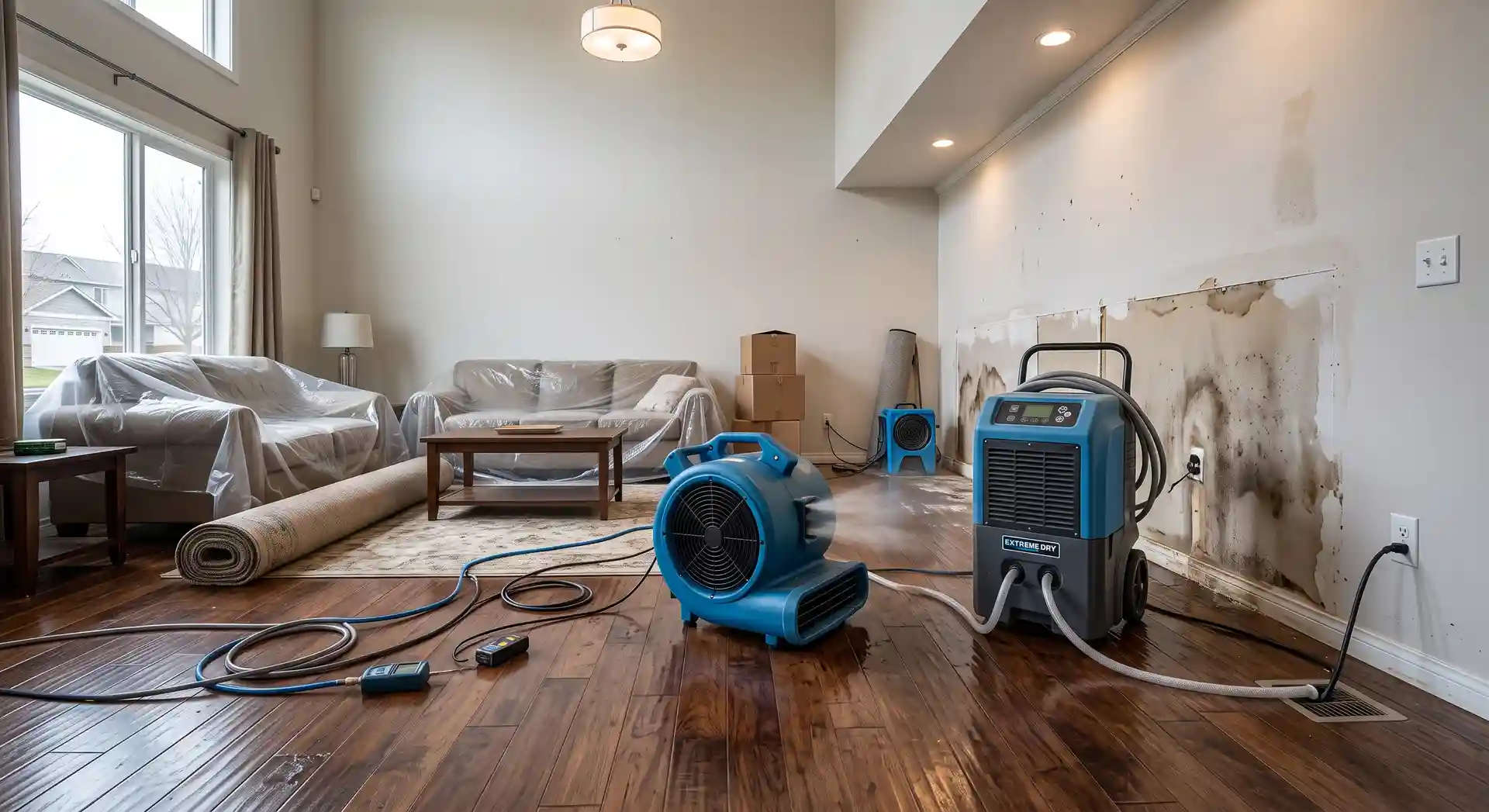
To achieve maximum drying efficiency, our restoration specialists at Water Extraction Now follow a proven four-tier methodology:
-
Extraction: Removing liquid water using truck-mounted vacuum systems. Extraction is 500 times more efficient than evaporation.
-
Evaporation: Utilizing industrial air movers positioned at 45-degree angles against wet surfaces.
-
Dehumidification: Deploying Refrigerant or Desiccant dehumidifiers to pull airborne vapor out of the room.
-
Temperature Control: Adjusting ambient heat between 70°F and 90°F to maximize vapor pressure differential.
For further steps on mitigating immediate leaks, check out our guide on [Internal Link: Emergency Water Mitigation Checklist].
Hidden Risks of Incomplete Drying
Stopping the drying process prematurely because surfaces feel dry leads to severe secondary damage:
-
Mold Growth: Mold spores germinate within 24 to 48 hours of initial water exposure.
-
Dry Rot: Wood-decay fungi thrive in timber with moisture content exceeding 20%.
-
Structural Instability: Fasteners pull away from softened drywall studs and swollen subfloors.
-
Consult official public health advice via the EPA Guide to Mold, Moisture, and Your Home for exposure standards.
How to Accelerate the Drying Process at Home
If you are dealing with a localized clean-water spill, implement these immediate actions:
-
Mop & Squeegee Immediately: Extract as much surface water manually as possible.
-
Create Cross-Ventilation: Open windows if outside humidity is below 50%.
-
Run Air Conditioning: Central HVAC units naturally pull humidity out of ambient air.
-
Elevate Furniture: Place aluminum foil or plastic blocks under furniture legs to stop wood stain bleeding.
-
Discover more DIY safety protocols in our breakdown of [Internal Link: How to Prevent Secondary Water Damage].
Frequently Asked Questions (FAQ)
Can water dry on its own without fans?
While water will eventually evaporate on its own, natural drying usually takes over 7 days. This extended timeline guarantees mold growth and structural warping. Active drying equipment is always recommended.
How do I know if moisture is completely gone?
Surface touch tests are unreliable. Professional restorers use pin-type and non-penetrating moisture meters along with thermal imaging cameras to verify that sub-surface materials have reached dry standard baseline readings.
Does boiling heat dry water faster inside a house?
Excessive heat without adequate dehumidification creates a “sauna effect.” This high vapor pressure bakes moisture deeper into drywall and ceilings, accelerating mold growth instead of drying the property.
Summary & Next Steps
So, how long does it take for water to dry? Under optimal conditions with professional extraction, air movement, and dehumidification, most structural materials dry within 3 days. Without equipment, moisture remains trapped long enough to initiate severe mold growth and structural decay.
If your property has suffered a pipe burst, appliance leak, or sudden flooding, don’t rely on guesswork. Contact our certified structural drying specialists at Water Extraction Now today for immediate moisture inspection and professional extraction services.